Choosing Healthcare Marketing Software That Actually Integrates With Your Practice Tools
The fastest way to lose leads, double-book patients, and waste staff hours is running healthcare marketing software that does not talk to your other medical practice management tools and the fix is consolidating onto one connected platform instead of stacking more disconnected ones.
Walk into most independent practices and you will find the same story. A scheduling tool that does not sync with the EHR. A separate system for email campaigns. Another one for texting patients. A review management tool bolted on top. A CRM that nobody actually updates because it means re-entering data that already lives somewhere else.
Each tool was probably a reasonable decision on its own. Together, they create a practice that is running on five logins, five sources of truth, and zero visibility into what is actually happening with a lead from the moment they inquire to the moment they become a patient.
The Real Cost of a Disconnected Tech Stack
When software does not integrate, the gaps get filled by staff time, or they do not get filled at all. Neither outcome is good.
Consider what happens with a typical stacked setup. A lead fills out a form on the website. That form feeds into a marketing tool, but not the scheduling system. A staff member has to notice the new lead, manually enter it into the scheduling platform, and then remember to follow up by phone because the marketing tool cannot trigger a text through the phone system. If that staff member is out sick, on a lunch break, or simply buried, the lead sits untouched.
Multiply that across every new inquiry, every appointment reminder, and every post-visit follow-up, and the pattern becomes clear: a disconnected stack does not just create inefficiency, it creates silent revenue loss that never shows up on an invoice because it never became a patient in the first place.
The most common symptoms of a disconnected stack include:
Leads that go unanswered because no single system owns the follow-up
Duplicate or conflicting patient records across platforms
Staff spending hours a week on manual data entry between systems
No single dashboard showing which marketing efforts are actually producing booked patients
Appointment reminders and marketing messages that are timed independently and sometimes contradict each other
Billing and scheduling data that has to be reconciled by hand at the end of the month
None of these problems are caused by any one tool being bad. They are caused by tools that were never designed to work together being asked to run a single, connected patient journey anyway.
Why Practices End Up Stacked in the First Place
Almost no physician sets out to build a fragmented stack on purpose. It happens gradually. A practice starts with a basic scheduling tool. Marketing becomes a priority, so a separate email platform gets added. Patients start asking to text instead of call, so a texting tool gets layered on. Reviews become important for visibility, so a review management subscription joins the pile.
Each addition solves an immediate problem. But because these tools are typically chosen independently, by whoever is dealing with that specific pain point at that specific moment, nobody is evaluating the stack as a whole. The result, a year or two later, is a practice paying for six or seven subscriptions that overlap in some places, leave gaps in others, and require someone to manually bridge the difference every single day.
All-in-One Platform vs. Stacked Tools: What Actually Changes
The difference between a stacked tech setup and a unified platform is not just convenience. It changes what is operationally possible for the practice.
Data Visibility
Stacked tools: Patient and lead data lives in separate systems that rarely sync in real time, if at all. Getting a full picture of a single patient's journey means checking three or four different logins and hoping the information lines up.
Unified platform: Every interaction, from the first form submission to the most recent appointment to the last text exchange, lives in one record. Staff can see the complete picture in a single view, and leadership can see exactly which marketing activity is producing booked, paying patients.
Automation Depth
Stacked tools: Automation is limited to whatever a single tool can do in isolation. A marketing platform can send an email, but it usually cannot trigger a text, update a scheduling calendar, and flag a billing follow-up based on the same event, because those systems were not built to hand off to each other.
Unified platform: One trigger can set off a full sequence across every channel and function, because the marketing, scheduling, communication, and billing layers are part of the same system. A missed appointment can automatically trigger a rebooking text, update the schedule, and notify staff, all from one event.
Staff Time
Stacked tools: Someone has to manually move information between systems, reconcile discrepancies, and manage multiple logins and permissions. This is invisible administrative overhead that rarely gets counted but consistently eats hours every week.
Unified platform: Data enters once and is available everywhere it is needed. The manual bridging work disappears because there is nothing left to bridge.
Cost Over Time
Stacked tools: Multiple subscriptions, each with its own pricing tier, often scale independently as the practice grows, and the combined cost is rarely evaluated against what a consolidated platform would cost for the same functionality.
Unified platform: One subscription covers the functionality that would otherwise require several tools, and pricing scales with the practice rather than with the number of separate vendor relationships being managed.
Vendor Accountability
Stacked tools: When something breaks, whether that is a missed text, a scheduling conflict, or a lead that fell through, it is often unclear which vendor is responsible, and support tickets bounce between companies that do not talk to each other.
Unified platform: One vendor is accountable for the entire patient journey working correctly, which means problems get diagnosed and fixed faster because there is nowhere for the responsibility to hide.
What to Look for in Healthcare Marketing Software
Not every platform marketed as "all-in-one" actually delivers on that promise. Physician founders evaluating options should look past the pitch and check for a few specific things.
True integration, not just a shared login: Some platforms bundle separate products under one brand without actually connecting the underlying data. Ask directly whether a lead captured through marketing automatically appears in scheduling, and whether a scheduling change automatically updates any active nurture sequence for that patient.
HIPAA compliance built into the core platform: not added as an afterthought. Every tool touching patient data, from text reminders to intake forms, needs to meet compliance standards without requiring a separate compliance layer bolted on top.
Reporting that shows the full funnel: A platform should be able to show, in one place, how many leads came in, how many converted, how long that took, and how much revenue resulted, without exporting data from multiple systems into a spreadsheet to get the answer.
Room to grow: The right medical practice management tools should handle a solo practice today and scale to multiple providers or locations later without requiring a full platform migration.
Common Questions
Is switching to a unified platform disruptive to a practice that is already running?
A well-managed migration is designed to avoid disruption. Data is transferred, staff are trained, and automations are rebuilt before the old systems are turned off, so patients and staff experience the transition as an improvement rather than an interruption.
Do I have to give up tools my staff already know well?
Sometimes a stacked tool is genuinely best-in-class and worth keeping through an integration rather than a full replacement. The goal is a connected system, not necessarily eliminating every existing tool, though in most practices the honest answer is that consolidation saves both money and staff time.
How do I know if my current stack is actually costing me patients?
Look at how consistently leads are followed up with, how often appointment data has to be manually corrected, and whether anyone in the practice can answer, without checking multiple systems, exactly how many leads came in last month and what happened to each one. If that answer is not immediately available, the stack is likely costing more than the subscription fees suggest.
What size practice benefits most from consolidating onto one platform?
Any independent practice benefits, but the return grows with the number of moving parts. A solo practice with light marketing activity may feel the pain less acutely than a multi-provider practice running active lead generation, but both are typically better served by one connected system than by several disconnected ones.
One System, Built for How Practices Actually Grow
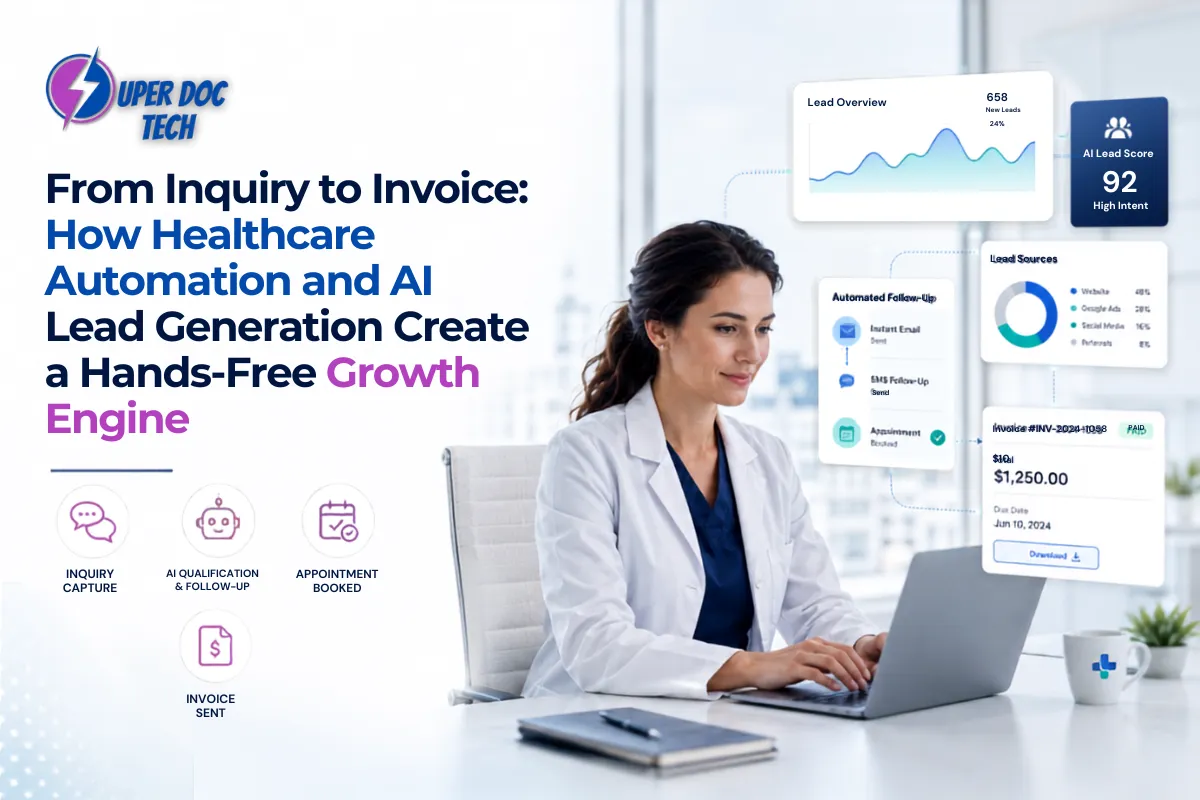
The physicians running the most predictable growth in 2026 are not the ones with the most tools. They are the ones running the fewest tools that do the most, connected in a way that means a lead captured on a Tuesday night is followed up on, booked, treated, billed, and brought back for their next visit without anyone having to manually stitch the process together.
That is the difference between healthcare marketing software that checks a box and one that actually runs your practice's growth.
If your team is juggling logins instead of running one connected system, book a free strategy call with Super Doc Tech. We will look at what you are currently running, show you exactly where the gaps are costing you patients, and walk you through what a single, fully connected platform looks like for your practice.
