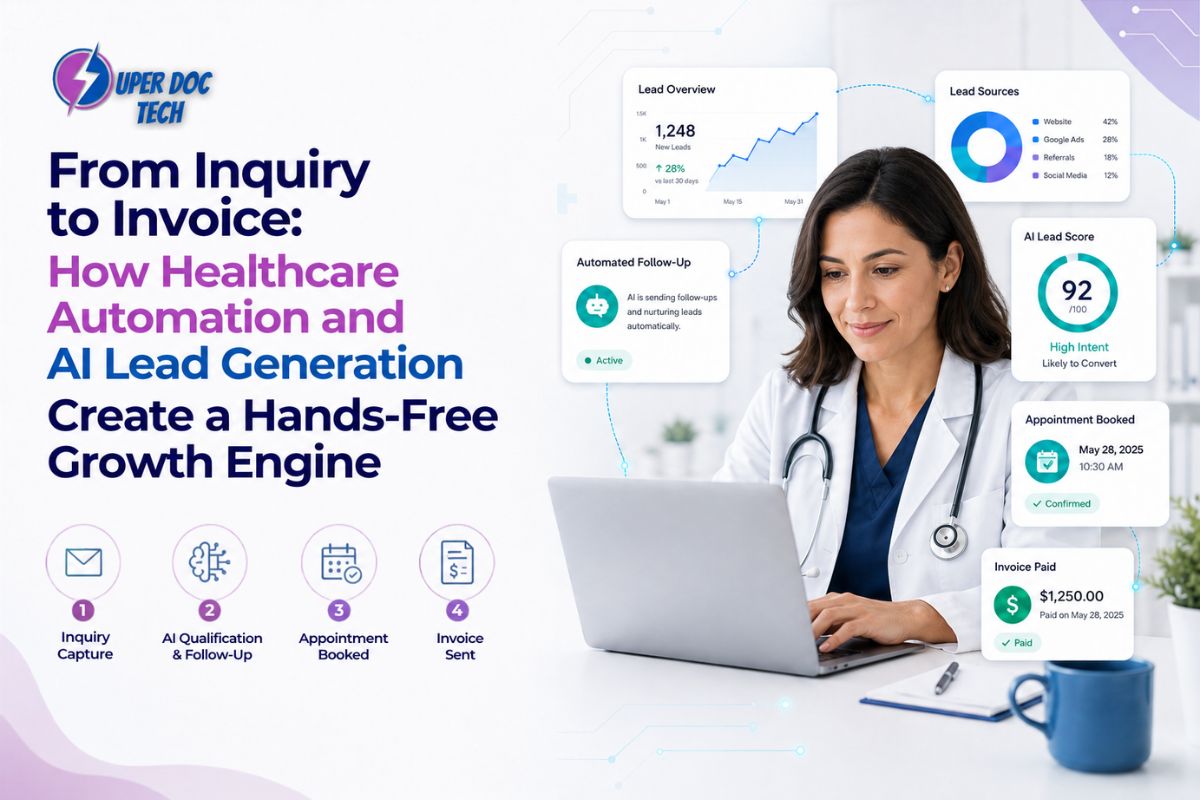
How Healthcare Automation and AI Lead Generation Create a Hands Free Growth Engine
Healthcare business process automation and an AI lead generation system work together to capture every inquiry, nurture it automatically, convert it into a booked visit, and follow up after the invoice is paid, without a staff member touching most of the steps in between.
Most physician founders think about growth in two disconnected pieces. Marketing brings in leads. The front desk turns leads into patients. What almost nobody maps out is everything that happens between those two events, and everything that should happen after.
That gap is where revenue disappears. A lead calls, nobody answers, and the lead books with the practice down the street instead. A patient finishes treatment, gets no follow-up, and never rebooks. An invoice goes unpaid because nobody sent a reminder. Each of these is a small leak. Together, across hundreds of leads a year, they represent the difference between a practice that grows predictably and one that grows by accident.
This is the case for treating your practice's growth as a single connected system, from the first inquiry to the final invoice, built on healthcare business process automation and an AI lead generation system that hands off to each other seamlessly.
What Is Healthcare Business Process Automation?
Healthcare business process automation is the use of software to run the repetitive, rules-based tasks inside a practice, lead response, scheduling, reminders, billing follow up, patient recall, without requiring a staff member to initiate each one manually. It does not replace clinical judgment. It replaces the administrative work that happens the same way every time, whether that is sending a confirmation text or flagging an overdue invoice.
Paired with an AI lead generation system, which identifies, engages, and qualifies new patient interest before a human ever gets involved, the two form a single pipeline. One brings people in. The other keeps every step after that moving without anyone having to remember to do it.
Mapping the Full Patient Journey
To see where automation actually plugs in, it helps to walk the journey a patient takes from the moment they first hear about your practice to the moment their account is settled.
Stage 1: Lead Capture
A prospective patient finds your practice through a Google search, a social ad, a referral link, or a form on your website. This is the moment an AI lead generation system does its first job: capturing that inquiry the instant it happens, regardless of channel, and logging it in one place instead of scattering it across a call log, an inbox, and a sticky note at the front desk.
The data on response speed is stark. Practices that respond to a new inquiry within five minutes convert at roughly ten times the rate of practices that take an hour or longer, and the average practice still takes closer to two days. An AI-driven intake system sends an instant, personalized response around the clock, including nights, weekends, and the exact moment a patient is most motivated to book.
Stage 2: Qualification and Nurture
Not every lead is ready to book on day one. Some are comparing providers. Some are waiting on insurance confirmation. Some are simply still deciding. This is where most practices lose the most ground, because manual follow-up is inconsistent by nature, one coordinator remembers to call back, another does not, and leads quietly go cold.
An AI lead generation system solves this by asking qualifying questions automatically, tagging the lead by intent and urgency, and routing it into the right nurture track. From there, healthcare business process automation takes over the sequence itself: a text the same day, an email with answers to common questions two days later, a value-focused message addressing a typical objection a week out. Every message is timed and personalized, and none of it requires a human to press send.
Stage 3: Conversion
By the time a lead is ready to book, the friction that kills conversions is usually logistical, a phone tag loop, a scheduling link buried in an email, a form that asks for information the patient already provided. Automated booking removes that friction entirely. The patient taps a link, selects a time, and receives an instant confirmation. No hold music, no waiting for a callback.
This stage is also where automation quietly protects revenue that would otherwise leak out through no-shows. Automated reminders at 48 hours and 24 hours before an appointment have been shown to cut no-show rates by roughly 28 to 54% compared to practices relying on manual reminder calls.
Stage 4: Visit and Invoice
The appointment itself is where automation steps back and clinical care takes over, this is intentionally the one stage that stays fully human. But the administrative work surrounding the visit does not have to be. Automated billing workflows can generate and send the invoice immediately after the visit, follow up on unpaid balances on a set schedule, and flag accounts that need a real conversation before they escalate. Practices that automate this step typically see faster average payment cycles simply because reminders go out consistently instead of whenever someone remembers.
Stage 5: Follow-Up and Retention
Growth does not end at the invoice. The highest-return, lowest-cost patients any practice has are the ones already in its database. A well configured automation system sends a check-in message the day after a visit, requests a review 24 hours later, and if the patient has not returned within a set window, triggers a reactivation campaign automatically.
Recall campaigns built on this kind of automation typically convert 15 to 25% of recipients into a booked follow-up appointment, at close to zero cost per message. For a practice with a few hundred patients on file, that single workflow can represent tens of thousands of dollars in recovered revenue every year that would otherwise require a marketing budget to replace.
Why AEO and GEO Matter for This Growth Engine
There is a layer above the funnel itself that physician founders increasingly need to think about: how patients are finding practices in the first place. Search behavior has shifted. A growing share of patients now ask AI assistants like ChatGPT, Google's AI Overviews, or Perplexity questions like "best dermatologist near me for acne scars" instead of typing a traditional search query.
This is where Answer Engine Optimization (AEO) and Generative Engine Optimization (GEO) come in. AEO structures your practice's content, service pages, FAQs, blog posts, so that AI systems can extract a clear, direct answer and cite your practice as the source. GEO goes a step further, making sure your practice's information is consistent, structured, and authoritative enough across the web that generative AI tools surface it confidently when a patient asks a question in natural language.
Traditional SEO still matters for ranking in classic search results, but a practice that only optimizes for SEO is now leaving an entire emerging channel of patient discovery untapped. The practices that show up in AI-generated answers today will have a meaningful visibility advantage as this becomes the default way people search for care.
Common Questions
What is the difference between healthcare business process automation and an AI lead generation system?
Business process automation runs the operational tasks of the practice, reminders, follow-ups, billing, recall, on a set schedule or trigger. An AI lead generation system focuses specifically on capturing, qualifying, and engaging new inquiries before they enter that operational flow. In a mature practice, the two are connected so a new lead flows directly into the automated nurture and scheduling system without a manual handoff.
Will this replace my front desk or billing staff?
No. It removes the repetitive, rules-based tasks, sending the fifth reminder text, chasing a $40 balance, logging a lead from a form, so your team's time goes toward the conversations that genuinely need a person, like a patient with a complex question or a difficult financial situation.
How long does it take to see results from a system like this?
Most practices see measurable movement within four to eight weeks. Reactivation and billing follow-up tend to show results fastest, since they work on patients already in the system. New lead capture and nurture compound over a longer window as the pipeline builds.
The Practices Winning in 2026 Treat Growth as One System
Physician founders do not need five disconnected tools and a mental checklist of who is supposed to follow up on what. They need one system that captures the lead, nurtures it, books it, bills it, and brings the patient back, without requiring a staff member to babysit each handoff.
That is what a connected healthcare business process automation and AI lead generation system actually delivers: fewer leaks, faster conversions, and a practice that keeps growing whether or not anyone is actively managing it that day.
If you want to see what this looks like built specifically for your practice, book a free strategy call with the Super Doc Tech team. We will map your current patient journey, show you exactly where it is leaking, and walk you through what a hands-free system would look like from the first inquiry to the final invoice.
