AI Is Replacing the Front Desk
How AI Is Replacing the Front Desk: Voice Assistants and Smart Marketing for Modern Physician Practices
Your front desk is the first impression every patient gets of your practice. It is where bookings are made, questions are answered, and relationships begin. But it is also one of the most overwhelmed, understaffed, and inconsistent parts of most independent practices.
The average medical practice misses about 23% of all incoming calls. Nearly 34% of patients hang up after waiting just two minutes on hold. And when a new patient cannot reach you, they do not leave a voicemail. They Google the next doctor on the list and book there instead.
AI is changing that reality completely, and the practices that are adapting right now are pulling ahead of everyone still relying on a single front desk coordinator to do the work of an entire team.
What Is Happening at the Front Desk Right Now
Most independent practice front desks are managing an impossible workload. A single coordinator is expected to answer phones, verify insurance, confirm appointments, respond to online inquiries, manage no-shows, and greet walk-in patients, all at the same time.
The result is predictable. Calls go unanswered. Follow-ups get delayed. Leads fall through the cracks. Patients feel ignored before they have even had their first appointment.
This is not a staffing problem. It is a systems problem, and AI is the solution that makes the workload manageable without burning out your team.
How AI Is Taking Over Front Desk Responsibilities
Modern AI tools are no longer just chatbots that answer basic questions. They are sophisticated systems capable of handling entire patient communication workflows with the kind of speed and consistency no human team can match.
Answering Calls Around the Clock
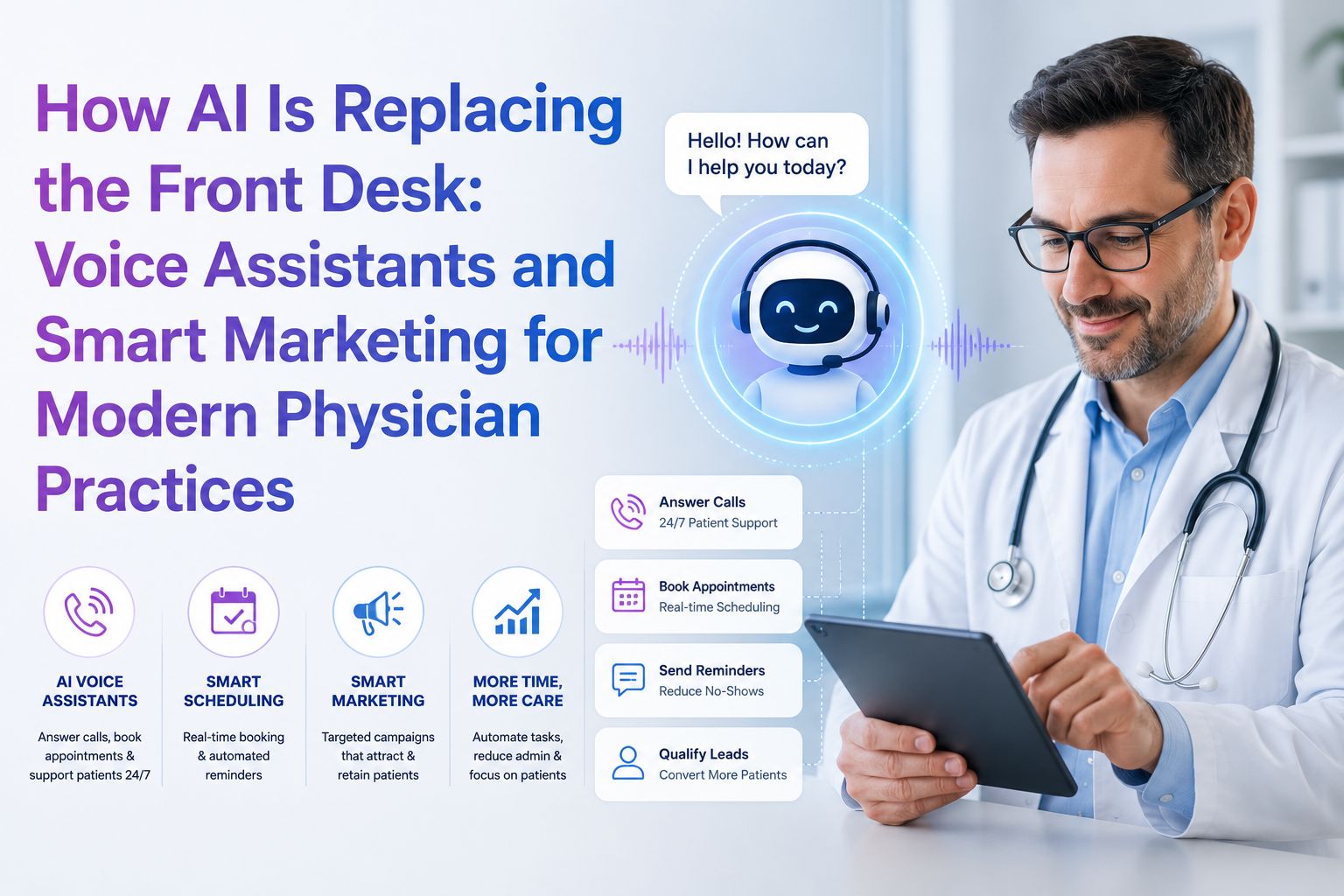
A healthcare voice assistant can answer every inbound call, day or night, within seconds. It handles appointment inquiries, confirms availability, answers frequently asked questions, and books appointments directly into your calendar without any staff involvement.
When a patient calls at 9pm on a Sunday night, your AI answers. When three patients call simultaneously on a Monday morning, all three are served without anyone being placed on hold.
Booking and Confirming Appointments
AI-powered booking tools sync directly with your practice calendar. They allow patients to self-schedule online or over the phone in real time, send instant confirmation messages, and trigger automated reminders 24 and 48 hours before the appointment.
The result is fewer no-shows, a fuller schedule, and a front desk team that is no longer buried in scheduling calls all day.
Handling FAQs and Patient Inquiries
What are your hours? Do you accept this insurance? Where are you located? How do I prepare for my appointment?
These questions consume enormous amounts of front desk time every single day. An AI assistant handles all of them instantly, accurately, and without frustration, freeing your team to focus on the patients who are physically in front of them.
AI Marketing for Doctors: What It Actually Means
AI at the front desk handles incoming communication. AI marketing for doctors handles outbound growth, and the two together create a complete patient acquisition and retention engine.
Here is what AI-driven marketing does for an independent physician practice specifically:
Lead response automation: when a new inquiry comes in through your website, social media, or a paid ad, AI responds within minutes, not hours. Studies show patients are ten times more likely to convert when contacted within five minutes of inquiry.
Personalized nurture sequences: AI sends the right follow-up message to the right patient at the right time, based on where they are in their decision-making journey.
Reactivation campaigns: AI identifies dormant patients in your database and automatically reaches out with relevant messaging to bring them back without anyone on your team having to manually pull a list.
Review generation: after a positive appointment, AI triggers a review request automatically, building your online reputation on autopilot.
Content and SEO support: AI tools analyze what your ideal patients are searching for and help produce content that puts your practice in front of them before they even know to look for you specifically.
With 66% of US physicians now using AI tools in their practice, up from 38% in 2023, this is no longer a competitive advantage. For practices that have not yet adopted it, it is quickly becoming a competitive disadvantage.
The Voice Assistant Advantage: Always On, Never Burned Out
The healthcare voice assistant is arguably the single most impactful AI tool an independent practice can implement right now. Here is why.
It Never Misses a Call
Your human staff has an 8-hour window. Your AI voice assistant has a 24-hour window. Every call that comes in outside business hours, every call that arrives during a busy patient rush, every call your team simply could not get to, is now answered.
It Qualifies Leads Instantly
A well-configured voice assistant does not just answer questions. It gathers information. It asks patients about the reason for their visit, their insurance, their preferred appointment time, and their contact details. By the time your team sees the interaction log in the morning, the lead is already qualified and ready to confirm.
It Escalates When It Should
The best AI systems know when to hand off to a human. If a patient expresses distress, describes a medical emergency, or asks a clinical question that requires physician input, the system escalates immediately. AI handles the routine. Your team handles the human moments that actually require them.
Common Questions About AI at the Front Desk
Will patients feel like they are talking to a robot?
Not with a properly built system. Modern AI voice assistants use natural language processing that sounds genuinely conversational. Most patients cannot distinguish a well-configured AI from a trained human receptionist over a standard phone call. The key is in how the system is built and personalized to your practice voice and patient community.
What happens if the AI cannot answer a question?
A good system is built with clear escalation rules. Any question or situation outside the AI's defined scope gets routed immediately to a human team member or flagged for follow-up. The AI never guesses on clinical matters and never leaves a patient without a path forward.
Is this HIPAA compliant?
It must be, and any reputable platform will confirm it. Before deploying any AI voice or messaging tool that touches patient information, confirm full HIPAA compliance and ensure a Business Associate Agreement is in place. This is non-negotiable.
How long does it take to set up?
Most AI front desk and marketing systems can be fully operational within a few weeks when built on the right platform. The setup involves training the system on your practice information, integrating it with your calendar and CRM, and testing call flows before going live.
What This Looks Like for a Real Independent Practice
Picture a family medicine physician running a solo practice with one front desk coordinator. Before AI, the coordinator was managing 40 to 60 calls a day alongside in-office responsibilities. Calls were being missed. Follow-ups were inconsistent. The physician was spending weekend mornings reviewing a backlog of messages.
After implementing an AI voice assistant and automated marketing system, the picture changes completely:
New patient inquiries receive an instant response at any hour
The booking system fills the schedule without the coordinator managing every slot manually
Dormant patients are reactivated through automated campaigns the physician never has to touch
Reviews accumulate consistently because the system requests them after every visit
The coordinator spends her time on patient experience rather than call volume
The practice did not hire more staff. It built a smarter system.
The Practices Winning in 2026 All Have One Thing in Common
They stopped trying to grow their practice by working harder and started building systems that grow it for them.
AI-driven marketing and voice automation are not futuristic concepts anymore. They are the infrastructure that separates the independent practices thriving in today's competitive healthcare landscape from the ones quietly losing patients to slower response times, missed calls, and inconsistent follow-up
