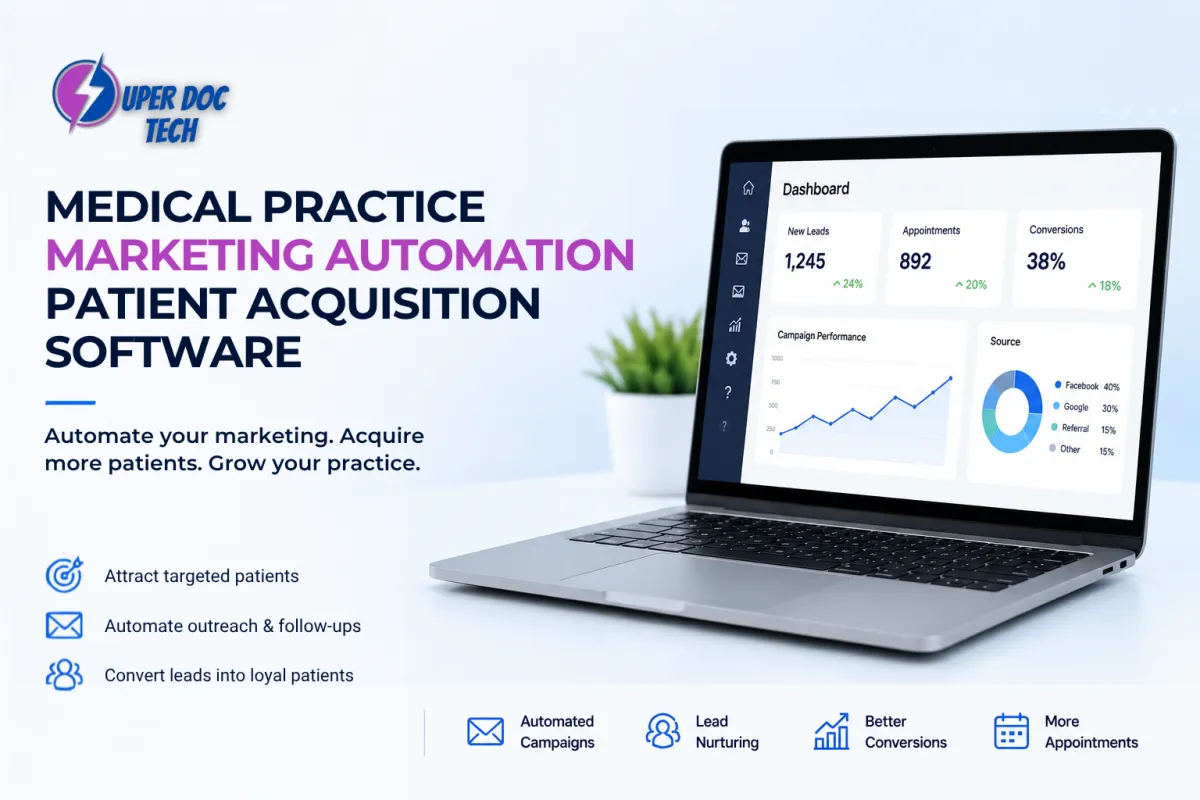
Stop Chasing New Patients - Let Medical Marketing Automation Systems Do It For You
There is a version of running an independent practice that most physicians never get to experience. One where new patient inquiries arrive consistently, follow-ups happen automatically, dormant patients come back without anyone making a single call, and the schedule fills itself without the physician spending a minute of their day managing any of it.
Most physicians are running the opposite version. They are posting on social media hoping something sticks, manually following up with leads that came in three days ago, watching their ad budget disappear without knowing what it actually produced, and starting each week uncertain whether the schedule will be full or half-empty.
The difference between these two versions of practice ownership is not budget. It is not specialty. It is not market size. It is systems.
Why Chasing Patients Is a Losing Strategy
When a physician's growth plan depends on manual effort, it scales with the physician. Every new patient requires someone's time to attract, follow up with, convert, and retain. And since physician time is the most finite resource in any practice, growth eventually hits a ceiling that no amount of harder work can break through.
The numbers confirm how expensive this approach has become. By late 2025, the average patient acquisition cost for private practices reached approximately $312, up sharply from under $200 just three years earlier. For competitive specialties like orthopedics or aesthetics, that number climbs to $400 to $600 per new patient. Meanwhile, most practice websites convert only 2 to 5% of their visitors into actual inquiries, and only 1 in 9 of those inquiries eventually becomes a booked patient.
Every one of those failure points represents money and time spent on outreach that produced nothing. And in most cases, the problem is not the marketing channel. It is the absence of a system to capture and convert the interest that already exists.
What Medical Practice Marketing Automation Actually Does
Medical practice marketing automation is not about replacing the human elements of patient care. It is about removing humans from the tasks that should never have required them in the first place.
Here is what that looks like in practice:
A new lead comes in through your website at 8pm on a Thursday. An automated response goes out within minutes, introducing your practice, answering the most common initial questions, and providing a direct link to book an appointment.
The lead does not book that night. The next morning, an automated follow-up text goes out. Two days later, an email. A week later, a value-focused message that addresses a common concern for patients considering your specialty.
The lead books on day nine. A confirmation goes out instantly. A reminder follows 48 hours before the appointment and again 24 hours out.
The patient attends their first visit. The following day, an automated check-in message goes out. Twenty-four hours after that, a review request lands in their inbox.
Three months later, if they have not returned, a reactivation message goes out.
Not a single one of those touchpoints required a staff member to initiate it. Every one of them would have been missed without automation in place.
The Patient Acquisition Funnel Most Practices Are Leaking From
Before automation can help, it is worth understanding exactly where most independent practices are losing patients. The funnel has four main stages, and the majority of practices leak from all four simultaneously.
Stage 1: Awareness
Patients cannot book with a practice they have never heard of. Most practices rely on a combination of Google search, online reviews, and word of mouth to drive awareness. The challenge is that over 70,000 health-related searches happen on Google every minute, and practices without a consistent content and SEO strategy are invisible to the majority of that traffic.
Stage 2: Inquiry
A patient finds your practice and reaches out. This is where the average response time of 47 hours destroys conversion rates. Research consistently shows that patients contacted within five minutes of inquiry are ten times more likely to convert than those contacted after an hour. Without automation triggering an instant response, most practices are competing at a severe disadvantage.
Stage 3: Conversion
The patient has expressed interest but has not yet booked. This is where nurture sequences do the work that no busy coordinator has time to do consistently. Automated follow-up campaigns keep the practice top of mind, address objections, and make booking as easy as tapping a single link on a phone.
Stage 4: Retention
A booked patient is not a retained patient. Practices that automate post-visit follow-up, review requests, and recall campaigns see automated follow-ups increase repeat appointments by approximately 32% compared to practices that rely on patients to initiate return visits on their own.
What Patient Acquisition Software Changes About This Picture
Patient acquisition software is the infrastructure that manages the entire funnel above without requiring constant human oversight. When configured correctly for a physician practice, it functions as a silent growth engine running in the background of everything the practice does.
The core capabilities that matter most for independent practices are:
Lead capture and instant response: every inquiry from every channel lands in one system and triggers an immediate, personalized response. No lead sits unanswered regardless of when it arrives.
Multi-channel nurture sequences: leads that do not convert immediately enter an automated sequence across text, email, and in some cases direct mail, each message timed and personalized based on where the patient is in their decision process.
Reactivation campaigns: dormant patients in the existing database are identified automatically and re-engaged through targeted outreach. Well-configured recall campaigns typically convert 15 to 25% of recipients into booked appointments at near-zero cost per message, making reactivation one of the highest-return activities any practice can run.
Review generation: automated post-visit review requests sent at the optimal time generate significantly more reviews than manual processes. Practices below a 4.0 star rating lose more than 40% of potential patients before those patients ever contact the practice, making reputation management a direct patient acquisition issue.
Performance tracking: every campaign, every sequence, and every channel is tracked so the practice always knows exactly which efforts are producing patients and which are not.
The Reactivation Opportunity Nobody Talks About Enough
Every independent practice is sitting on an asset they almost never fully use: their existing patient database.
Consider a practice with 800 patients on file. If even 20% of them are dormant, that is 160 people who have already chosen this practice, already experienced the care, and already trust the physician. Re-engaging them costs a fraction of what it costs to acquire a cold lead from paid advertising.
A single automated reactivation campaign sent to that dormant segment, offering a timely reason to return, whether a wellness check, a new service offering, or a seasonal health prompt, can generate thousands of dollars in recovered revenue without a dollar of ad spend.
Practices running recall campaigns report conversion rates of 15 to 25% from recipients, and at an average appointment value of $150 to $300, even a small active patient base of 500 can generate $10,000 to $20,000 in recall-driven revenue per month from one automated workflow alone.
That revenue is sitting in every practice's database right now. The only thing missing is the system to reach it.
Common Questions
Will automated messages feel impersonal to patients?
Only if they are written generically. The best automation is built in the physician's voice, references the practice's specific services and community, and is timed intelligently based on patient behavior. A well-written automated follow-up text often feels more personal than a rushed call from a coordinator managing 50 other tasks simultaneously.
Does this replace my front desk team?
No, It replaces the manual, repetitive tasks that prevent your team from doing their best work. When automation handles lead follow-up, appointment reminders, and reactivation campaigns, your team has more capacity for the patient interactions that genuinely require a human, meaning better care, better patient experience, and better retention.
How do I know which patients to target with reactivation campaigns?
A properly configured patient acquisition system segments your database automatically based on last visit date, service history, and engagement behavior. You set the rules once and the system identifies and reaches out to the right patients on an ongoing basis without anyone pulling a list manually.
How long before I see results?
Most practices see measurable results within the first four to eight weeks. Reactivation campaigns typically produce the fastest results because they target patients who already know and trust the practice. New patient nurture sequences take slightly longer to build momentum but compound over time as the lead database grows.
What Stops Most Physicians From Implementing This
The most common reason independent physicians do not have automation in place is not cost. It is bandwidth.
Building and configuring a marketing automation system requires time and expertise that most physician-founders simply do not have on top of managing a full patient schedule. So it stays on the to-do list indefinitely while the practice continues losing leads, missing follow-ups, and running reactivation campaigns that never actually run.
This is exactly why the most effective implementations are not self-built. They are built by teams who specialize in physician practice growth, who understand the compliance requirements, who know what sequences convert for healthcare rather than e-commerce, and who can get the system operational without the physician having to become a marketing technologist.
The physician's job is to configure the strategy once and then let the system run. Every week it runs without intervention is a week of patient acquisition that required zero physician time.
The Practices Growing in 2026 Are Not Working Harder
They built smarter systems.
Companies leveraging AI and automation in their marketing reduce customer acquisition costs by approximately 25%. Healthcare practices using automated reminder and nurture systems see no-show rates drop by 28 to 54%. Personalized automated engagement boosts patient retention measurably compared to practices relying on manual outreach.
These are not numbers from enterprise health systems with nine-figure budgets. They are outcomes available to any independent practice that implements the right infrastructure.
The physicians who are growing their practices predictably in 2026 are not spending more hours chasing leads. They are running a patient acquisition system that does the chasing for them, around the clock, without a day off, and at a cost per patient that shrinks as the system matures.
If you are ready to stop doing this manually and start doing it systematically, book a free strategy call with the Super Doc Tech team. We will show you exactly what the right automation system looks like for your practice, your specialty, and your growth goals.
