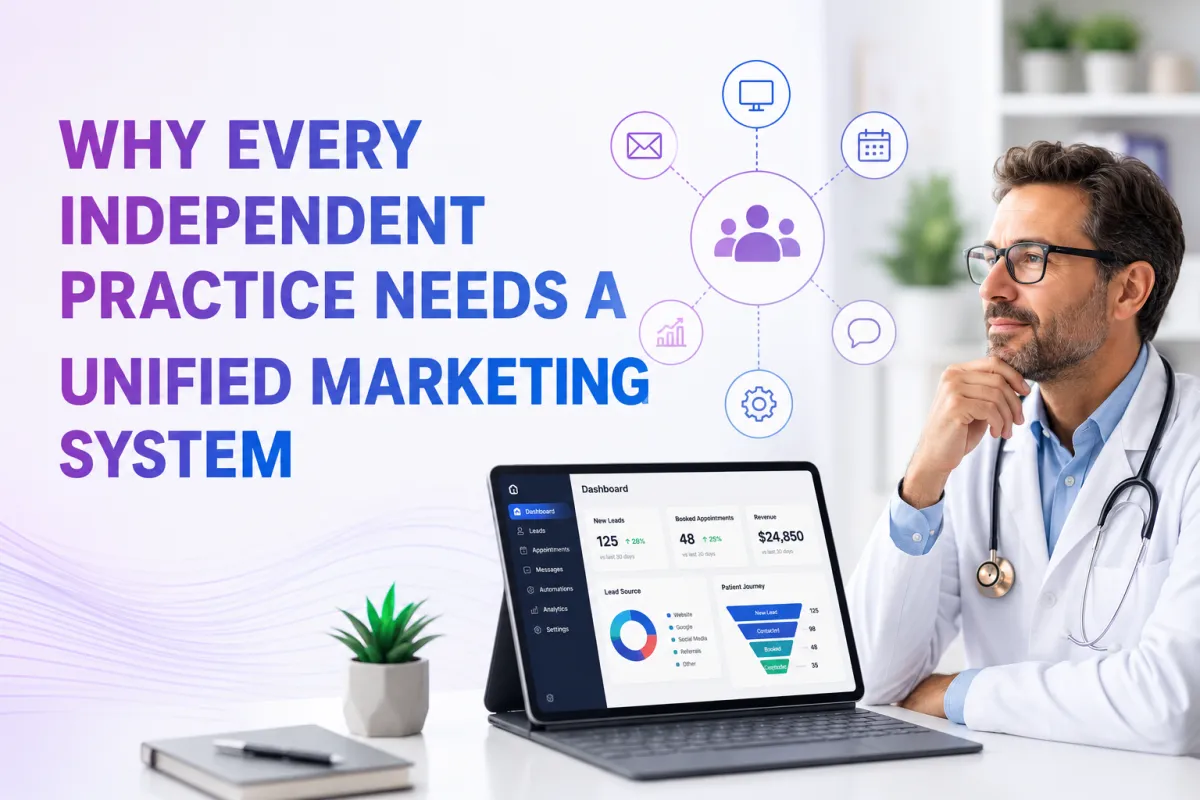
Why Every Independent Practice Needs a Unified Marketing System
You became a physician to practice medicine, not to manage a maze of disconnected software subscriptions, chase down leads that fell through the cracks, or wonder why your marketing spend never seems to translate into new patients sitting in your chair.
Yet that is exactly where many independent practice owners find themselves today. According to recent data, fewer than 50% of physicians now remain in independent practice, and one of the biggest silent killers of growth is a fragmented technology and marketing stack that creates more confusion than clarity.
The solution is not more tools. It is the right system. One connected, physician-specific medical practice marketing system that eliminates the chaos and puts consistent revenue growth on autopilot.
The Hidden Cost of a Disconnected Marketing Stack
Ask most independent physicians how their marketing is performing and you will get a shrug. Not because nothing is happening, but because no one can tell where patients are actually coming from.
The average practice today runs on five to seven separate software tools. A website hosted on one platform, emails sent through another, appointment reminders coming from a third, social media scheduled somewhere else, and patient leads living in a spreadsheet no one has time to update. Each tool does its job in isolation and none of them talk to each other. When a lead comes in on a Tuesday night, it sits unanswered for an average of 47 hours, and by that point the patient has already booked with someone else.
Studies show that patients contacted within five minutes of an inquiry are ten times more likely to convert. That number is almost impossible to hit without automation, and automation only works when your tools are unified under one system.
The real cost of fragmentation is not just inefficiency. It is revenue walking out the door every single day.
What a Unified Medical Practice Marketing System Actually Looks Like
A true medical practice marketing system is not a single piece of software. It is an interconnected ecosystem where every patient touchpoint, from the first Google search to the post-appointment follow-up, flows through one coordinated infrastructure.
Your website is not just a digital brochure. It is a lead capture engine connected directly to your CRM, your booking system, and your automated follow-up sequences. Your CRM tracks every lead, every interaction, and every stage of the patient journey so nothing falls through the cracks. Automated nurture sequences engage new inquiries instantly via text and email, keeping your practice top of mind while you are with patients. Online booking syncs with your calendar and sends automated appointment reminders that reduce no-shows without anyone lifting a finger. Social media and content drive consistent organic traffic back into the same funnel rather than into a separate universe with no connection to your revenue.
When these pieces operate together, your marketing becomes a predictable growth engine rather than a collection of expensive experiments.
Why Healthcare Marketing Automation Is the Engine, Not a Nice-to-Have
Let's be clear about what automation does and what it does not do. It does not replace the physician-patient relationship. It protects it.
Healthcare marketing automation handles the repetitive, time-sensitive tasks that your team simply cannot keep up with manually. It follows up with a lead within minutes of inquiry. It sends pre-appointment education to a new patient before they even walk through your door. It re-engages a patient who has gone silent for 90 days and triggers a review request 24 hours after a positive visit.
Without automation, these moments are missed. With it, they happen consistently at scale without adding a single hour to your workday or a single headcount to your payroll.
Consider what this means for patient reactivation alone. If your practice has 1,000 past patients and 15% of them are dormant, a single automated reactivation campaign can generate tens of thousands of dollars in recovered revenue from people who already know and trust you. No ad spend required.
Physicians using automated reactivation and nurture systems routinely report measurable results within the first few weeks, not because they found new patients, but because their system finally captured the opportunity that was already sitting in their database.
Common Questions (FAQs)
Do I need a marketing system if I am just starting my practice?
Yes, and arguably more so than an established practice. Starting without a system means you are building on a broken foundation. Every patient who inquires and gets no response, every lead that slips through because your booking is buried on page three of your website, that is lost revenue you cannot recover. Building the right infrastructure from day one is dramatically cheaper than trying to fix a fragmented stack two years into your practice.
What is the difference between a marketing system and a marketing agency?
A marketing agency runs campaigns for you. A marketing system is the infrastructure that captures, converts, and retains patients with or without paid campaigns. Agencies profit when you spend more on ads. A system produces results only when your practice grows. The most powerful outcome is when both work together, but the system must come first because without it, ad spend generates leads that nobody follows up on.
Will AI-driven automations sound generic or impersonal?
Only if they are built generically. When automations are trained on your voice, your specialty, and your patient community they read as authentic because they are. The best systems are not templates with your name dropped in. They are custom-built workflows that reflect how you actually communicate, scaled beyond what any single person could manage manually.
Is this HIPAA compliant?
It depends entirely on the platform. Any CRM, automation tool, or communication system that handles patient data must be HIPAA compliant and should include a Business Associate Agreement. This is non-negotiable. When evaluating any marketing system, confirm HIPAA compliance before sharing any patient information with the platform.
The Three Stages Where a Unified System Changes Everything
Regardless of where you are in your practice journey, a unified system solves different but equally critical problems at every stage.
Stage 1: Launching a New Practice
Your most urgent need is patient acquisition infrastructure. You need a website that converts visitors, a booking system that works around the clock, and an automated follow-up sequence that turns inquiries into confirmed appointments before you even see your first patient. Practices that launch with this infrastructure already in place routinely onboard patients before opening day simply because the system is ready to capture and convert interest from the very beginning.
Stage 2: Established Practice Adding Cash Services
You already have the most valuable asset in healthcare marketing, which is a list of patients who trust you. A unified system lets you segment that list, launch targeted campaigns for your new cash-pay or concierge offerings, and enroll existing patients into new revenue streams with minimal friction. The opportunity is already inside your database and the system makes sure you reach it before it goes cold.
Stage 3: Scaling a Proven Practice
At this stage the problem is not attracting patients. It is managing growth without burning out. A fully automated system means newsletters go out on schedule, social content posts consistently, leads are nurtured around the clock, and your team focuses on patient care rather than manual outreach. You scale revenue without scaling chaos.
What Physicians Actually Experience When They Unify Their Marketing
The shift from scattered tools to a unified growth system is not just operational. It is a complete change in how you experience running your practice. When you know exactly where your patients are coming from, when follow-ups happen automatically, and when your marketing machine runs while you are with patients, you get your focus back.
Physicians who make this transition consistently report three outcomes. First, clarity. They finally know which channels are producing patients and which are wasting money. Second, consistency. Patient acquisition becomes predictable instead of feast or famine. Third, capacity. With administrative and marketing workflows automated, they reclaim hours every week to spend on the work that actually brought them into medicine.
One geriatric psychiatrist generated over $30,000 in his first two weeks after implementing a unified growth system, not by spending more on ads, but by finally having a system that converted the interest that already existed into actual booked revenue.
Your Practice Deserves a System, Not a Subscription Pile
Independent practice is worth protecting. Patients benefit when physicians maintain ownership of their care environments. But protection requires infrastructure, and in 2026, that infrastructure is a unified marketing and operations system built specifically for how physician practices grow.
The question is not whether you need a system. You already do. You are just running six of them instead of one, and the gaps between them are costing you more than you realize.
If you are ready to stop juggling disconnected tools and start building something that actually works, the first step is understanding exactly where your practice stands today. Take two minutes to assess your practice's current growth readiness and find out which gaps in your system are costing you the most.
