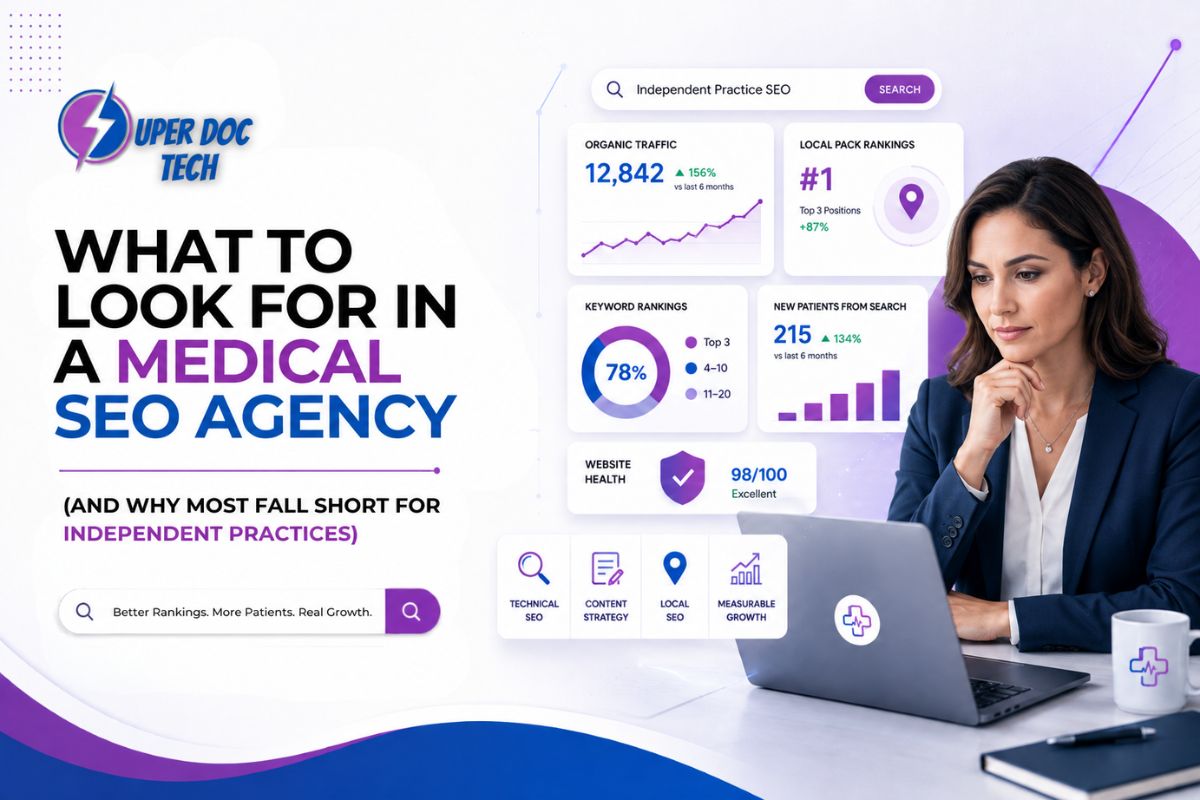
What to Look for in a Medical SEO Agency And Why Most Fall Short
A real medical SEO agency should be able to show you specific ranking movement, patient inquiries, and Google Business performance tied directly to their work and if an agency cannot show you that, you are paying for activity, not results.
Most independent physicians have a version of this story. They hired an SEO agency, paid a monthly retainer for six months to a year, and at the end of it could not point to a single new patient who came from that work. Traffic numbers might have moved. Rankings for some obscure keyword might have improved. But the phone did not ring more, and the schedule did not fill any faster.
This happens constantly in healthcare, and it is rarely because SEO does not work for medical practices. It works extremely well when it is done correctly. It fails because most agencies selling "medical SEO" are running the same generic playbook they use for restaurants, law firms, and retail businesses, with a few healthcare keywords swapped in.
Why Generic SEO Fails Medical Practices
Search engines treat medical content differently than almost any other category, and most agencies either do not know this or do not build their process around it.
Google classifies health-related searches under what it calls Your Money or Your Life content, meaning pages that can affect a person's health, finances, or safety are held to a stricter standard for accuracy, expertise, and trustworthiness than the average blog post or product page. A generic agency writing thin, keyword-stuffed content without medical review is not just producing weak results, it is often actively working against the practice's ability to rank at all.
On top of that, medical searches are overwhelmingly local. A patient searching for a dermatologist is not looking for the best dermatologist in the country. They are looking for the best one within a reasonable drive, available soon, accepting their insurance. An agency running a national SEO playbook without a strong local strategy is optimizing for the wrong outcome entirely.
What Real Medical SEO Actually Includes
Before evaluating any medical SEO agency, it helps to know what the work is actually supposed to include. Real medical SEO for an independent practice covers four connected areas, not just one.
Local SEO
For most practices, local search is where the majority of new patients come from. This means optimizing for "near me" searches, city and neighborhood-specific pages, and the local map pack that appears above traditional search results for most medical queries.
Local SEO done properly includes:
Location-specific service pages built for each city or region a practice actually serves
Consistent name, address, and phone number information across every directory and citation source
A steady stream of reviews, since review count and recency are one of the strongest local ranking factors for medical practices
Structured data that helps search engines understand exactly what services are offered where
Google Business Profile Management
A Google Business Profile is often the single most important asset a local practice has, and it is also one of the most neglected. Patients frequently make a decision based on the map pack listing alone, without ever clicking through to the website.
An agency that actually understands medical SEO will:
Post regular updates to keep the profile active, which search engines reward with better visibility
Respond to every review, positive and negative, since response rate itself affects ranking
Keep hours, services, and insurance information current
Use the Q&A and messaging features to capture inquiries directly from the listing
Answer Engine Optimization (AEO)
Search behavior has changed. A growing share of patients are asking AI tools like ChatGPT, Google's AI Overviews, and Perplexity direct questions such as "what is the recovery time for a knee replacement" or "which type of doctor treats chronic migraines," and getting a synthesized answer with source citations instead of a list of links.
AEO structures content so these AI systems can extract a clear, accurate, well-sourced answer and cite the practice directly. This typically means content written in a direct question-and-answer format, clear medical accuracy, and structured data that makes the page easy for an AI system to parse. An agency that has never mentioned AEO is optimizing for a search landscape that is already partially outdated.
Consistent, Original Content
Search engines reward practices that regularly publish original, medically accurate content addressing the actual questions patients are searching for. This is not about publishing for the sake of publishing. A single well-researched blog post addressing a specific patient question, published weekly and tied to the practice's actual services, does more for both traditional SEO and AEO than a dozen generic articles with no clear audience.
Consistency matters here as much as quality. Search engines and AI systems both weight freshness and publishing consistency when determining which sources to trust and surface, which means a practice publishing sporadically will lose ground to one publishing on a steady weekly cadence, even if the total volume of content is similar.
Questions to Ask Before Hiring a Medical SEO Agency
Most physicians evaluate SEO agencies based on a sales pitch and a portfolio of logos. The better approach is a short list of direct questions that separate agencies that actually understand medical SEO from ones repackaging a generic service.
Can you show me ranking and inquiry data from a practice in my specialty?
Any agency with real medical SEO experience should be able to show specific before-and-after data, not just general case studies. Vague answers here are a warning sign.
How do you handle Google's medical content standards?
The agency should be able to explain, specifically, how their content process addresses accuracy, medical review, and the stricter trust standards applied to health content. If they cannot answer this clearly, they likely are not aware it exists.
What does your local SEO process look like specifically for my location and specialty?
A real answer includes specifics about citation building, review strategy, and location-based content. A vague answer about "optimizing your website" is a sign the agency is running a generic template.
Do you address AEO and AI-driven search, or only traditional Google rankings?
This is becoming one of the clearest ways to separate agencies that are current on how search actually works today from ones still selling a 2018 strategy.
How often is content published, and who writes it?
Ask specifically whether content is written by someone with healthcare marketing experience or medical review, and whether the cadence is consistent enough to build momentum, rather than an occasional post whenever there is time.
What reporting will I actually see, and how often?
The right answer includes specific numbers: rankings for target keywords, Google Business Profile performance, inquiries attributed to organic search, not just a generic traffic report that does not connect to patient volume.
Common Questions
How long does medical SEO take to show results?
Meaningful movement typically starts within three to four months, with more significant results building over six to twelve months. Anyone promising fast, dramatic ranking changes for competitive medical keywords is either overpromising or using tactics that put the practice at risk of a search engine penalty.
Is local SEO or content marketing more important for an independent practice?
They are not separate priorities. Local SEO determines whether a practice shows up for nearby searches at all, while consistent content builds the authority and relevance that search engines and AI systems use to decide which local results to trust and rank higher.
What is the difference between a general SEO agency and the best SEO company for doctors specifically?
A general agency applies the same process across every industry. A medical-focused agency understands healthcare compliance, medical content standards, patient search behavior, and the local and AEO dynamics specific to how patients actually find and choose a provider.
Should I manage SEO in-house instead of hiring an agency?
For most independent practices, the specialized knowledge required, medical content standards, local citation management, technical SEO, and now AEO, makes an experienced agency more cost-effective than building that expertise internally, especially when physician time is the practice's scarcest resource.
Choosing an Agency That Actually Understands Healthcare
The physicians who get real results from SEO are not the ones who spend the most. They are the ones who hired an agency that treats medical SEO as its own discipline, with its own standards, its own search behavior, and its own path to actually filling a schedule, rather than a generic service with a healthcare label attached.
If you have spent money on SEO before and cannot point to the patients it produced, that is worth a direct conversation. Book a free strategy call with Super Doc Tech, and we will show you exactly what a medical SEO strategy built around local search, Google Business optimization, AEO, and consistent original content looks like for your specific practice.
